
How has the River Roe performed against its management target over the last 11 years, and why does 2026 matter?
The River Roe has a management target of 1,833 spawning salmon. This figure is not arbitrary. It represents the number of adult salmon required to reach spawning areas and produce enough young fish to sustain the population into the future.
The obvious question is: how has the Roe performed against that target in recent years?
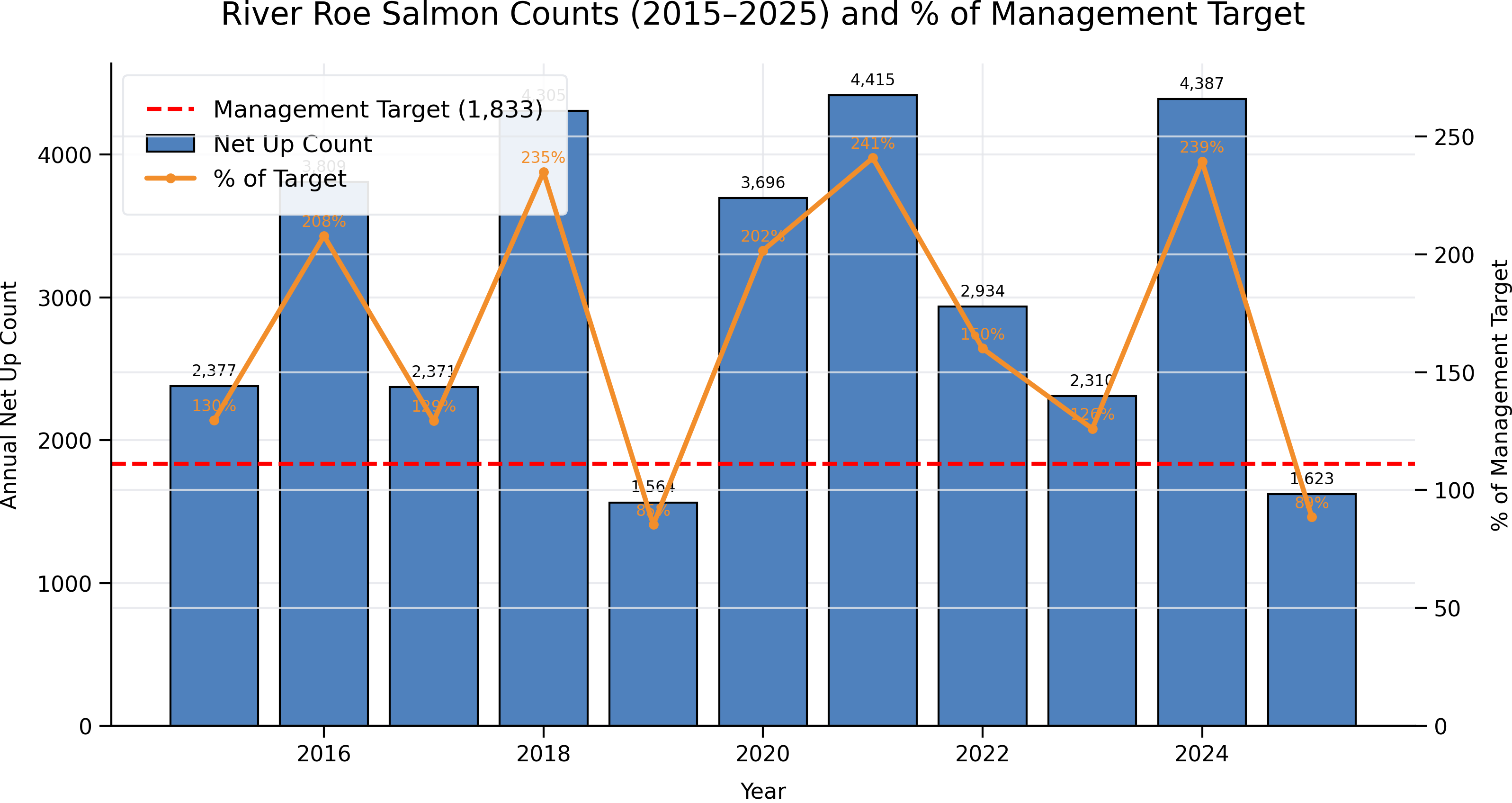
The chart below shows annual fish counter returns on the River Roe between 2015 and 2025, together with the percentage of the management target achieved each year.
A River That Has Often Performed Strongly
The data reveal that the Roe has generally performed well over the last decade.
Between 2015 and 2024 the river exceeded its management target in all but one year. Several years produced salmon runs more than double the target, including:
• 2016 - 3,809 salmon (208% of target)
• 2018 - 4,305 salmon (235% of target)
• 2021 - 4,415 salmon (241% of target)
• 2024 - 4,387 salmon (239% of target)
These figures demonstrate that the Roe remains one of the most productive salmon rivers in the wider Foyle system and continues to support salmon returns despite the many challenges facing Atlantic salmon.
The Importance of 2019 and 2025
The graph also shows that success is far from guaranteed.
In 2019, only 1,564 salmon were recorded, equivalent to 85% of the management target.
More recently, 2025 saw a return of 1,623 salmon, approximately 89% of target. Following several excellent years, the decline came as a sharp reminder that salmon populations remain vulnerable to a range of pressures.
No single factor can explain annual fluctuations. Salmon stocks are influenced by a complex combination of marine survival, river conditions, droughts, floods, predation, water quality and broader environmental change. A good year is therefore welcome, but it should never be interpreted as a guarantee of future success.
Why Meeting the Target Matters
When salmon numbers exceed the management target, more fish reach the spawning grounds. This increases the likelihood of successful reproduction and helps build resilience within the population.
Conversely, when returns fall below target, fewer fish contribute to the next generation. A single poor year is not necessarily cause for alarm, but repeated failures can begin to affect the long-term sustainability of the stock.
Looking Ahead to 2027
In 2026 the Roe once again faces an important test.
The river entered this season following a disappointing 2025 return, making this year's count particularly significant. Achieving or exceeding the 1,833 salmon management target would represent an important step in maintaining the long-term health of the stock and restoring confidence after last year's shortfall.
While many of the factors affecting salmon survival occur far beyond the Roe itself, there are still actions that anglers and local communities can support:
• Protecting water quality.
• Reporting pollution incidents.
• Respecting fishery regulations.
• Supporting habitat improvement initiatives.
• Practising voluntary catch and release where appropriate.
The River Roe has demonstrated remarkable resilience over the last decade. The challenge now is to ensure that resilience continues into the future.
The fish counter, although not perfect, provides an objective measure of how the river is performing. Every salmon that successfully reaches spawning areas this year will help shape the future of the Roe's salmon population for years to come.
